October 2026 (1)
- Oct.
21
- 2026
IEEE Talk: The Last Wireless Algorithms Designed by Humans
2026-10-21T14:30:00.000Z,
2026-10-21T14:30:00.000Z
–
2026-10-21T16:00:00.000Z
Walter Light Hall, Room 314, 19 Union St
Hosted by Kingston Section Chapter, C16/COM19
Co-hosted by Newfoundland Labrador Sect Chap, C16/COM19/CAS04; Kingston Section;
Abstract
Cell-edge rate is how next-generation networks get judged, and almost none of the utilities we actually optimize target it. Percentile programs do. They are also non-convex, non-smooth and strongly NP-hard. This talk follows that one problem across four papers, and at each step there is less of the algorithm left for a person to design.
It begins with sum-least-q-th-percentile rate maximization, which puts the fraction of users you care about directly into the objective and recovers max-min and sum-rate at its two ends. Two fractional transforms make it block-concave, giving cyclic algorithms that reach stationary points orders of magnitude faster than SCA or SQP, and the same idea carries over to MU-MIMO beamforming through a somewhat unexpected equivalence with a percentile-WMSE problem. Work in progress moves all of this to cell-free massive MIMO, where coherent joint transmission breaks the concavity and a change of variables puts it back.
Then the solver goes away. A neural network trained directly on the non-smooth utility, differentiating through the sort itself, matches the optimum where one is known and runs three to four orders of magnitude faster.
Then the designer goes away too! Given an immutable evaluator and a page of instructions, an AI agent ran eighty-one experiments over twenty-six hours and came back with a model within half a percent of the best solver we have, at roughly 600× lower inference cost, and with a small theorem attached: the parameterization it found is exactly max-min optimal at the minimum percentile, whatever the weights turn out to be.
I will close on what is left for us to do, and the path forward for us as wireless researchers.
Speaker Biography
Ahmad Khan (M’IEEE) received the Ph.D. and M.A.Sc. degrees from the Department of Electrical and Computer Engineering at the University of Toronto, Canada, in 2023 and 2017, respectively, and the B.S. degree in Electrical Engineering with First Class Honours from King Fahd University of Petroleum & Minerals (KFUPM), Dhahran, Saudi Arabia, in 2015. During his graduate studies, he was awarded the Edward S. Rogers Fellowship, the Wallberg Memorial Fellowship, the Ontario Graduate Scholarship, and the Queen Elizabeth II Graduate Scholarship in Science and Technology.
In 2021, he joined Ericsson Ottawa as a Machine Learning Engineer, and since 2023 has held a dual role there as Project Manager and Research Scientist in AI RAN R&D. In 2024, he was a visiting researcher at Ericsson Research in Stockholm, Sweden, and is an alumnus of the company’s prestigious Early Career Program. He also holds a patent in wireless resource management.
His research interests include wireless resource management — specifically beamforming and scheduling — and applied machine learning for next-generation wireless networks. He has published in IEEE Transactions on Signal Processing, including a two-part paper, IEEE Transactions on Communications, IEEE Transactions on Wireless Communications, IEEE Signal Processing Letters, IEEE GLOBECOM, and IEEE Access, among others. His work spans collaborations with academic institutions including Yale University and he also supervises graduate students and postdoctoral researchers at the University of Toronto through a funded research collaboration between Ericsson and the university.
Save to calendar:
December 2026 (1)
- Dec.
01
- 2026
IEEE NL OES-GRSS-APS invited APS YP Talk
2026-12-01T17:30:00.000Z,
2026-12-01T17:30:00.000Z
–
2026-12-01T18:30:00.000Z
Virtual
Hosted by Newfoundland-Labrador Sect Jt.Chap,OE22/GRS29/AP03
Speaker: Dr. Kamil Yavuz Kapusuz
Title:From Chip to System: A Holistic Approach to 2D Scalable Low-Loss D-Band Active Phased Array Realization
Abstract: The relentless demand for multi-gigabit wireless communication and high-resolution sensing drives rapid innovation in D-band (110–170 GHz) systems. However, realizing efficient and scalable active phased arrays at these frequencies remains challenging due to high cost, interconnect losses, packaging parasitics, and heterogeneous integration constraints. This talk presents a holistic, system-level approach to low-loss D-band phased array integration that unifies circuit, antenna, and packaging co-design. Leveraging both silicon-based (CMOS, SiGe) and III–V integrated circuits, the approach emphasizes optimized beamformer and power amplifier architectures combined with low-cost 2D scalable, wide-angle scanning wideband antenna arrays implemented using low-cost PCB processes. Through electromagnetic co-optimization and advanced interconnect engineering, the framework achieves significant reduction in loss and improvement in overall system efficiency. Measured D-band results from prototype modules demonstrate wide-angle beam steering and data transmission rates up to 100 Gb/s. These results confirm the feasibility of steerable, high-capacity arrays suitable for both communication and sensing platforms.
Short Bio: Kamil Yavuz Kapusuz (Senior Member, IEEE) received the M.Sc. degree in Electrical Engineering from Atilim University, Ankara, Turkey, in 2013, and the Ph.D. degree in Electrical Engineering from the Electromagnetics Group, Department of Information Technology, Ghent University, Belgium in 2021.
From 2014 to 2016, he worked as a Senior Antenna Engineer at Remote Sensing Technologies, Turkey. Between 2021 and 2022, he was a Visiting Scientist at the CNRS, IETR Laboratory, France. Since 2022, he has been a Senior Researcher in Electromagnetics at IMEC and Ghent University. His research includes on the analysis and design of quasi-optical systems, leaky-wave antennas, near-field focusing techniques, in/on-body communication systems, active/reconfigurable/unconventional millimeter-wave and sub-terahertz phased arrays, and electromagnetic modeling and optimization of 2.5D and 3D RF packaging architectures.
Dr. Kapusuz received the URSI Young Scientist Award at the 2021 URSI General Assembly.
Time: 2pm-3pm NST, 1 December, 2026
Webinar Link: https://mun.webex.com/meet/weimin
Webinar link: https://mun.webex.com/meet/weimin
Save to calendar:
November 2026 (2)
- Nov.
12
- 2026
NECEC 2026 - Sponsor Registration
2026-11-12T11:30:00.000Z,
2026-11-12T11:30:00.000Z
–
2026-11-12T20:30:00.000Z
Holiday Inn St. John's Conference Centre, Room , 180 Portugal Cove Rd.
Hosted by Newfoundland-Labrador Section
NOTE: This is the Sponsor Registration Page. For attendee registration, click here.
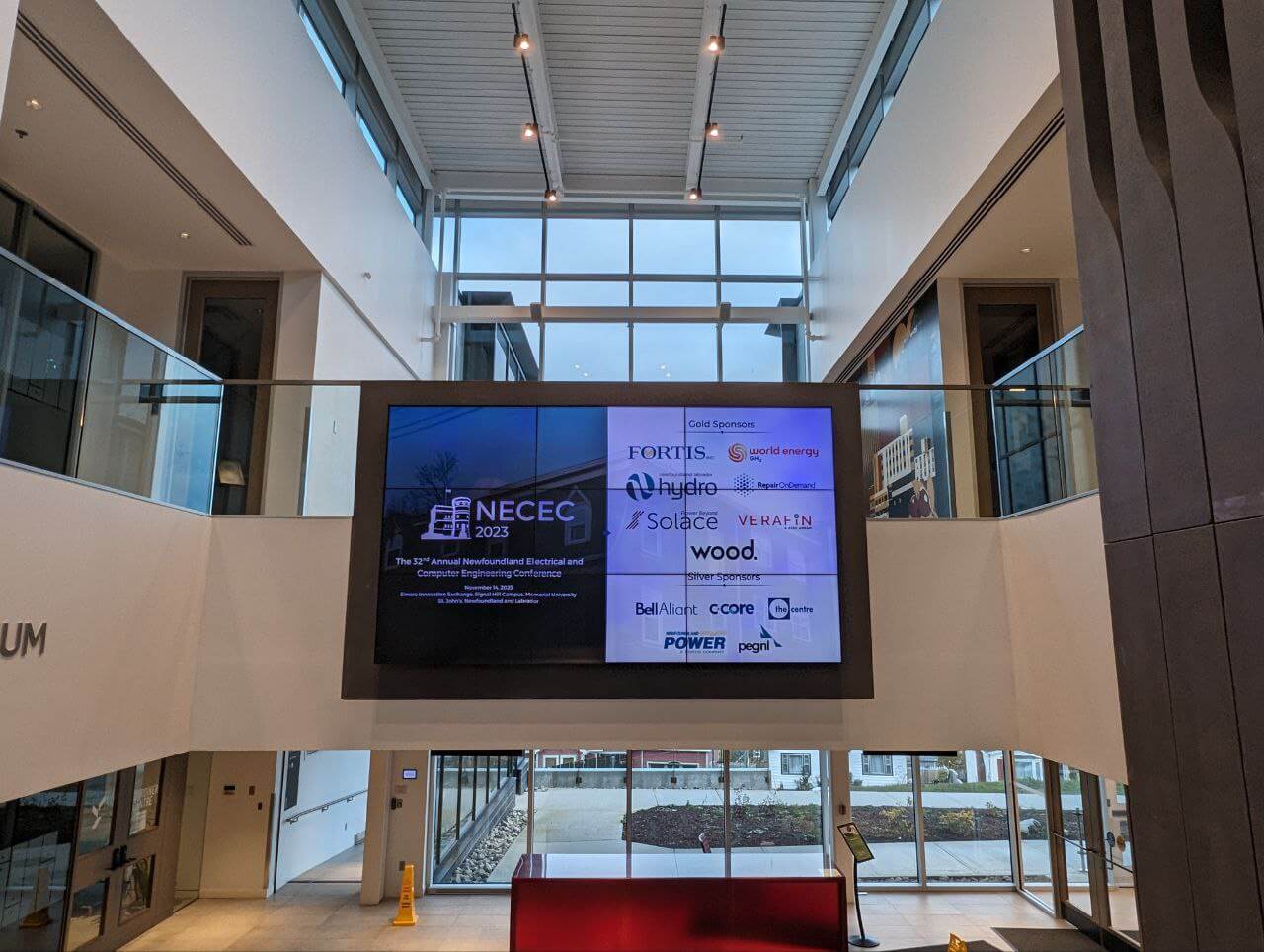
NECEC is presented by IEEE Newfoundland and Labrador Section in cooperation with Memorial University of Newfoundland as a forum where professionals in electrical, electronic and computer engineering as well as information technologies can present their work to the growing technical community within the province. The conference will focus on technical concepts, innovations and implementations.
Registered conferees will be provided with lunch, refreshment breaks, and conference proceedings.
Proceeds from this event and past conferences are used to sponsor IEEE Scholarships, which are awarded to students in Terms IV and VI of the Electrical Engineering or Computer Engineering program at MUN.
More information about this event can be found at the event website.
Save to calendar:
- Nov.
12
- 2026
NECEC 2026
2026-11-12T11:30:00.000Z,
2026-11-12T11:30:00.000Z
–
2026-11-12T20:30:00.000Z
Holiday Inn St. John's Conference Centre, Room , 180 Portugal Cove Rd.
Hosted by Newfoundland-Labrador Section
NECEC is presented by IEEE Newfoundland and Labrador Section in cooperation with Memorial University of Newfoundland as a forum where professionals in electrical, electronic and computer engineering as well as information technologies can present their work to the growing technical community within the province. The conference will focus on technical concepts, innovations and implementations.
Registered conferees will be provided with lunch, refreshment breaks, and conference proceedings.
Proceeds from this event and past conferences are used to sponsor IEEE Scholarships, which are awarded to students in Terms IV and VI of the Electrical Engineering or Computer Engineering program at MUN.
More information about this event can be found at the event website.
Save to calendar: